
Quality Policy
Premium extracts and customized nutraceuticals solutions to meet your business needs
Stage 01
Sorting
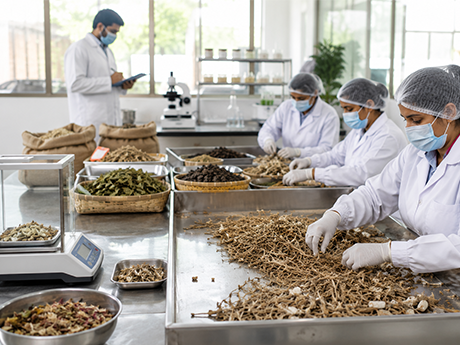
We place a great deal of emphasis on the origin of the raw material. Before any herbal raw material is allowed into our facility, we request a pre-ship sample for analysis. That sample is assessed using organoleptic methods alongside laboratory determination of yield and assay, and only once it is approved is the material authorised for order.
The reasoning is simple: by the time a poor lot reaches the extractor, the cost of it is already sunk. Rejecting at the grower rather than at our gate is the single most effective quality control we apply.
Once raw material arrives at our facility it is immediately quarantined for QC review. A qualified Quality Control member draws samples for immediate testing in our laboratory, and the material is released to production only after it clears. Sorting then removes foreign matter, damaged and undersized material, and — for root and rhizome crops — residual soil.
- Pre-shipment sampling
- Organoleptic and laboratory
- On arrival
- Quarantined until QC clearance
- Tested for
- Identity, yield, assay, moisture
- Plant part
- Verified by macroscopic examination
Stage 02
Extraction
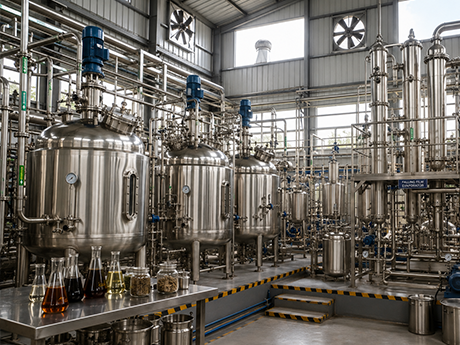
The core of our manufacturing process is the extraction area, which comprises systematically designed extractors, reactors and falling-film evaporators in stainless steel, accompanied by flame-proof circulation pumps and agitator motors to comply with fire safety norms.
Solvent systems are selected for the target compound class — aqueous, hydro-alcoholic and selective organic — rather than applied as a single house process. Extraction is matched to the molecule, because the conditions that suit a heat-stable resin will destroy a thermolabile active.
Concentration is carried out on falling-film evaporators, which give short residence time at low temperature. That is the difference between concentrating an extract and cooking it. Sufficient ventilation by natural means and enhanced wind turbines further ensures safety and a conducive working environment for our production team.
- Vessels
- Extractors, reactors, falling-film evaporators
- Construction
- Stainless steel throughout
- Solvent systems
- Aqueous, hydro-alcoholic, selective organic
- Concentration
- Falling-film, low temperature
- Safety
- Flame-proof pumps and agitator motors
Stage 03
Spray Drying
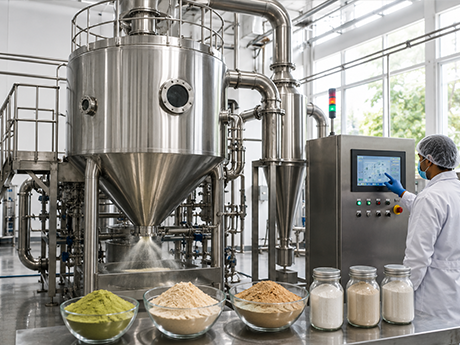
We use advanced spray-drying technology to convert liquid extracts into stable, free-flowing powders without compromising their natural properties. This process enhances shelf life, ensures consistent quality, and makes ingredients easier to handle and integrate into nutraceutical, pharmaceutical, food and cosmetic applications.
Inlet and outlet temperatures are set per product rather than per plant. An amla juice powder and a boswellia extract have entirely different thermal tolerances, and the profile that suits one will damage the other — vitamin C in particular is unforgiving of a hot inlet.
Carrier selection is part of the specification — maltodextrin, gum acacia or a natural alternative — and determines solubility, bulk density, hygroscopicity and flow. Carrier-free drying is available where a product will tolerate it.
- Equipment
- Stainless steel spray-drying plant
- Temperature profile
- Set per product
- Carrier options
- Maltodextrin, gum acacia, natural
- Output
- Free-flowing powder, declared bulk density
Stage 04
Finishing & Packing
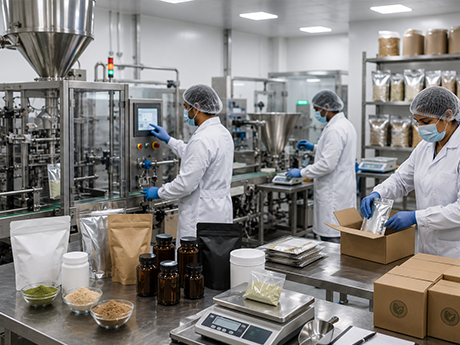
We ensure that every product is delivered in its purest and most stable form through meticulous finishing and packing. Our facilities are equipped with hygienic, controlled environments that maintain product integrity, while customisable packaging options — ranging from bulk to retail-ready — allow us to meet diverse client needs across the nutraceutical, pharmaceutical, food and cosmetic industries.
Material is milled and sieved to a declared mesh, blended to a specified assay where standardisation requires it, and homogeneity-tested before release rather than assumed from the batch record.
Packaging is specified around the material itself: hygroscopic powders receive double food-grade liners, oxidation-sensitive oils and carotenoids are nitrogen flushed, and light-sensitive pigments go into opaque containers. Private-label and customer-branded packing are available under contract.
- Milling & sieving
- To declared mesh specification
- Blending
- Assay-standardised, homogeneity tested
- Formats
- Bulk drums through to retail-ready
- Protective packing
- N₂ flush, double liner, opaque
- Private label
- Available under contract
Analytical scope
What we test
Scope is set per product — a natural colour is released on colour value, an essential oil on a GC profile, a milled powder on mesh and microbiology.
- Identity
- Macroscopy, TLC, HPLC / GC-MS fingerprint
- Assay
- HPLC, UV-Vis, GC, gravimetric, titrimetric
- Loss on drying
- Gravimetric, per product specification
- Ash
- Total ash and acid-insoluble ash
- Heavy metals
- Pb, Cd, As, Hg
- Microbiology
- TPC, yeast & mould, E. coli, Salmonella
- Residual solvent
- GC headspace, where applicable
- Pesticide residue
- On request, to destination market limits
- Particle size
- Sieve analysis to declared mesh
- Bulk density
- Tapped and untapped
Documentation
What ships with the lot
Certificate of Analysis
Lot-specific, reporting each result alongside the analytical method used to obtain it.
Specification sheet
Agreed limits for every released parameter.
Technical data sheet
Available from any product page using the spec sheet button.
Material safety data sheet
GHS-format MSDS for handling and transport.
Allergen & GMO statements
Declaration against the major allergen list.
Botanical origin declaration
Plant part, species and growing region for the supplied lot.
Residual solvent statement
Solvents used in extraction and the residual limits applied.
Shelf-life & stability data
Storage conditions and supporting stability information on request.
Certification
Standards and schemes
We publish only what is verifiable. Contact us for current certificate copies covering the specific product and destination market you are supplying into.
Schemes we work to
FSSAI
Food Safety and Standards Authority of India licence — mandatory for food-grade manufacture and supply within India.
ISO 9001
Quality management systems. The baseline scheme most international buyers screen for before a first order.
ISO 22000 / FSSC 22000
Food safety management, with FSSC 22000 adding GFSI recognition for global food and beverage customers.
GMP
Good Manufacturing Practice for nutraceutical and pharmaceutical-grade material, including AYUSH GMP for Ayurvedic preparations.
HACCP
Hazard Analysis and Critical Control Points — documented hazard identification across the process chain.
Kosher
Certification for supply into kosher-compliant supply chains.
Halal
Certification for supply into halal-compliant supply chains.
USDA / NPOP Organic
Organic certification for products where the crop and processing chain are both certified. Availability is botanical-specific and crop-season dependent.
Spices Board of India
Registration for export of spice extracts, oleoresins and essential oils.
Audits are welcome
Customer and third-party audits of our Doddaballapura facility are encouraged — generally before, not after, a long-term supply agreement is signed.